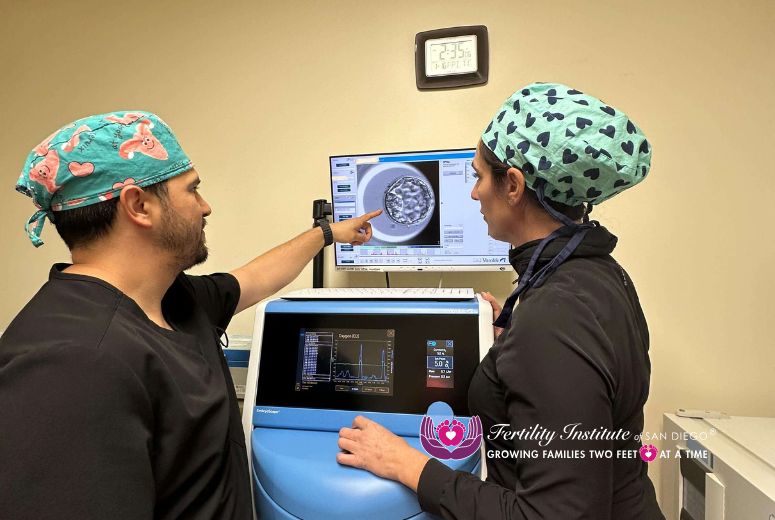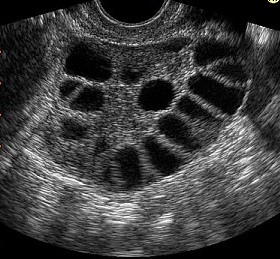


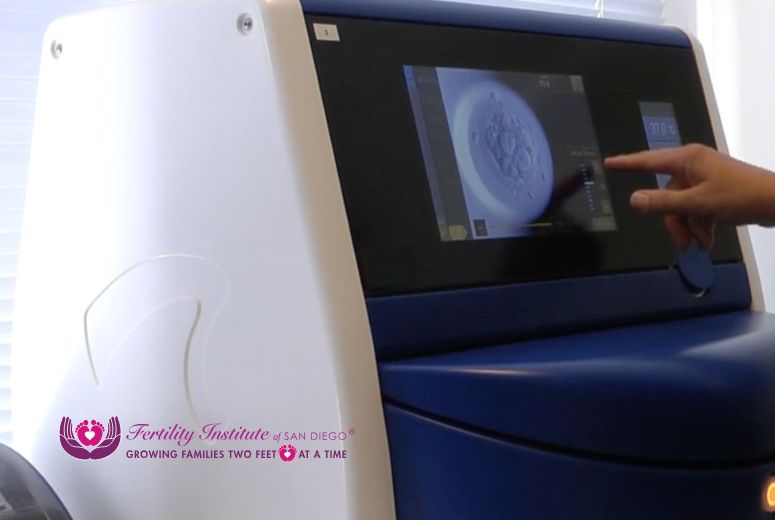
In vitro fertilization has evolved far beyond microscopic observation and static embryo grading. Today, embryoscope IVF technology introduces continuous embryo monitoring, refined data analytics, and AI-assisted IVF decision support that elevate both clarity and confidence during treatment.
At the Fertility Institute of San Diego, a leading fertility clinic San Diego patients trust for individualized care, advanced IVF lab technology San Diego standards converge with precision IVF philosophy. Understanding what is an embryoscope and how time-lapse embryo monitoring works empowers patients to participate in decisions that shape their reproductive future.
What Is an Embryoscope?
An embryoscope IVF system is a specialized IVF incubator equipped with high-resolution cameras that capture images of developing embryos at frequent intervals. Rather than removing embryos for periodic inspection, time-lapse embryo monitoring allows continuous embryo monitoring IVF within a stable, undisturbed environment.
In simple terms, it is an incubator and imaging system combined. The system:
- Captures images every 5 to 20 minutes
- Creates a time-lapse video of embryo development tracking
- Preserves optimal temperature, gas balance, and humidity
- Enables morphokinetic embryo assessment
Dr. Minoos Hosseinzadeh explains, “When we observe embryo development as a dynamic process rather than a single snapshot, we gain a deeper understanding of embryo implantation potential. The embryoscope IVF system allows us to see timing patterns that would otherwise remain invisible.”
How Traditional Embryo Monitoring Works
To appreciate the benefits of time-lapse embryo monitoring, it helps to understand embryoscope vs traditional IVF monitoring.
In conventional IVF San Diego laboratory settings:
- Embryos are removed from the incubator at specific time points
- Static grading evaluates appearance at that moment
- Cell division timing between observations may be missed
- Embryo grading relies heavily on subjective interpretation
While traditional IVF laboratory standards remain effective, they offer limited developmental snapshots. Many embryos appear morphologically similar at one time point. However, subtle differences in timing and cellular symmetry can significantly influence blastocyst development and embryo implantation potential.
How Time-Lapse Embryo Monitoring Works
Continuous Imaging
Time-lapse embryo monitoring records thousands of data points throughout early embryo development tracking. This continuous embryo monitoring IVF system evaluates:
- Exact timing of cell division
- Symmetry of blastomeres
- Degree of fragmentation
- Morphokinetic milestones
This morphokinetic embryo assessment provides a chronological map of embryogenesis.
Stable Incubation Environment
Because embryos remain undisturbed inside the embryoscope IVF incubator, environmental stress is minimized. There is no repeated exposure to fluctuating temperatures or gas concentrations, which supports optimal blastocyst development.
Developmental Pattern Tracking
Embryo development is not only about appearance but tempo. Subtle differences in cleavage timing correlate with implantation probability. Advanced embryo grading technology analyzes these kinetic variables rather than relying solely on visual morphology.
Where AI Comes In: AI-Assisted IVF
AI-assisted IVF integrates AI embryo selection technology into embryoscope IVF systems. Algorithms analyze developmental patterns, compare them against large datasets, and help prioritize embryos with higher predicted implantation potential.
At Fertility Institute of San Diego, Chloe AI embryoscope technology enhances precision IVF embryo selection.
Dr. Minoos Hosseinzadeh clarifies, “AI-assisted IVF does not replace clinical expertise. It supports our embryologists by identifying nuanced developmental patterns that complement human judgment.”
Chloe AI embryoscope systems evaluate timing intervals, cellular behavior, and advanced embryo grading technology metrics to assist in embryo prioritization. The final decision always rests with the clinical team.
Why Time-Lapse Monitoring Matters in IVF
- Improves embryo selection confidence
- Supports single-embryo transfer strategies
- Reduces unnecessary transfers
- Enhances consistency in embryo grading
- Assists in PGT embryo testing coordination
When embryo numbers are limited, as in IVF after 40 or diminished ovarian reserve cases, precision IVF becomes essential. AI-assisted IVF provides data-informed decision support that can guide both fresh and frozen embryo transfers.
Embryoscope and Precision IVF at FISD
Fertility Institute of San Diego is currently the only clinic in San Diego that includes AI-assisted EmbryoScope technology with Chloe AI as part of every IVF cycle.
This is not an optional add-on. It is integrated into all IVF San Diego treatment cycles as part of the precision IVF framework.
Precision IVF at this fertility clinic San Diego patients rely on combines:
- IVF lab technology San Diego innovation
- Individualized ovarian stimulation protocols
- Data-informed embryo prioritization
- Comprehensive in-house diagnostics
Dr. Minoos Hosseinzadeh states, “Precision IVF means aligning advanced laboratory science with individualized care. Every embryo tells a developmental story. The embryoscope IVF system allows us to interpret that story with greater clarity.”
Does an Embryoscope Improve IVF Success Rates?
Patients frequently ask about embryoscope success rates. The answer requires nuance.
Time-lapse embryo monitoring improves selection confidence and standardization. It does not guarantee pregnancy. Rather, it refines embryo prioritization, particularly when multiple embryos appear morphologically equivalent.
Studies suggest that continuous embryo monitoring IVF systems may support improved implantation outcomes in selected populations. However, IVF success depends on many variables including age, uterine receptivity, embryo genetics, and overall health.
Balanced expectations build trust. AI-assisted IVF is a powerful adjunct, not a guarantee.
Who Benefits Most From Embryoscope Technology?
- Patients over 35
- Recurrent IVF failure
- Limited embryo yield
- Donor egg IVF cycles
- Surrogacy IVF cycles
- International IVF patients with limited transfer opportunities
For donor egg IVF and surrogacy IVF cycles, precise embryo selection is critical. When intended parents travel internationally, continuous embryo monitoring IVF adds an additional layer of confidence.
Embryoscope vs Standard IVF Monitoring
| Standard Monitoring | Embryoscope Monitoring |
|---|---|
| Periodic checks | Continuous time-lapse |
| Embryo removal required | Embryos remain undisturbed |
| Static grading | Dynamic embryo development tracking |
| Fewer data points | Thousands of data points |
| More subjective assessment | AI-supported analysis |
This comparison illustrates how advanced embryo grading technology enhances the precision IVF framework.
FAQ
What is an embryoscope?
An embryoscope IVF system is a specialized incubator with built-in cameras that enables time-lapse embryo monitoring without disturbing embryo development.
How does time-lapse embryo monitoring work?
Images are captured every few minutes to create continuous embryo monitoring IVF videos. Morphokinetic embryo assessment tracks cell division timing and symmetry.
Is embryoscope technology safe?
Yes. Embryos remain in a controlled environment that maintains optimal IVF laboratory standards.
Does AI replace embryologists?
No. AI-assisted IVF supports embryologists by analyzing developmental data. Final decisions remain clinical.
Does embryoscope increase IVF success rates?
It improves embryo selection confidence but does not guarantee pregnancy.
Is AI-assisted IVF available in San Diego?
Yes. Fertility Institute of San Diego includes Chloe AI embryoscope technology in all IVF cycles.
If you are exploring IVF San Diego options and want clarity about how AI-assisted IVF and time-lapse embryo monitoring may support your journey, schedule a consultation.
If you’re ready to start your fertility journey, please book a complimentary virtual consultation with Dr. Hosseinzadeh, to go over fertility options or any other reproductive healthcare questions.