

For many patients beginning IVF treatment, the phrase “embryo quality” quickly becomes one of the most discussed and emotionally charged parts of the process. Patients often hear terms such as “good embryo,” “poor-quality embryo,” or “high-grade blastocyst,” yet few fully understand what these descriptions truly mean or how embryo quality affects IVF success.
The reality is more nuanced than most people expect.
Embryo quality is not determined by a single observation or isolated metric. Instead, it reflects a complex interplay between egg quality, sperm health, chromosomal integrity, embryo development patterns, laboratory conditions, and implantation biology.
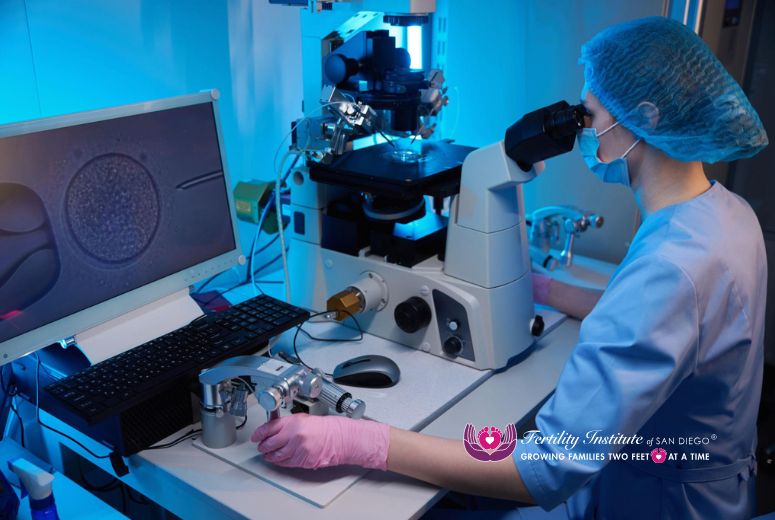
At Fertility Institute of San Diego, embryo assessment is approached through a precision-driven lens that combines embryology expertise with advanced AI-assisted embryo selection technology.
“Patients sometimes assume embryo quality is simply about how an embryo looks under a microscope. In reality, embryo development is highly dynamic, and successful implantation depends on many interconnected biological factors.”
Dr. Minoos Hosseinzadeh
What Does “Embryo Quality” Actually Mean?
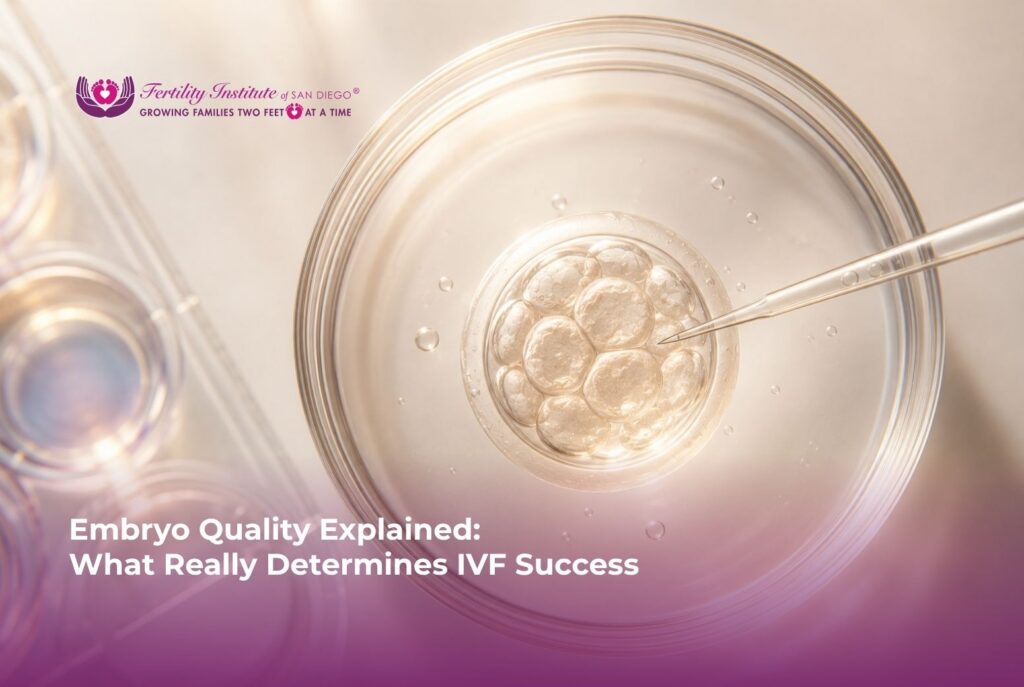
In IVF, embryo quality generally refers to an embryo’s developmental potential and likelihood of implantation.
When embryologists assess embryo quality IVF outcomes, they evaluate whether an embryo appears capable of:
- Continuing healthy cellular division
- Reaching the blastocyst stage
- Implanting into the uterus
- Supporting an ongoing pregnancy
However, embryo quality and genetics are not identical concepts.
An embryo may appear visually excellent while still carrying chromosomal abnormalities. Conversely, an embryo with less ideal morphology may still result in a healthy pregnancy.
This distinction is essential when understanding how embryo quality affects IVF success.
Key Factors Included in Embryo Quality Assessment
- Embryo morphology
- Cell division patterns
- Blastocyst development
- Chromosomal normality
- Developmental timing
- Cellular symmetry
- Fragmentation levels
How Embryos Develop During IVF
Understanding IVF embryo development stages helps patients better interpret embryo grading explained during treatment.
Fertilization
After egg retrieval, mature eggs are fertilized using either conventional IVF or ICSI.
Cleavage Stage
Over the next several days, embryos begin dividing into multiple cells. During this stage, embryologists evaluate:
- Cell number
- Symmetry
- Fragmentation
Morula Stage
As cell division progresses, the embryo compacts into a morula.
Blastocyst Stage
By days 5 to 7, embryos ideally reach the blastocyst stage. This stage is especially important because blastocysts have undergone significant developmental progression and provide more information about implantation potential.
Blastocyst development allows embryologists to assess:
- Inner cell mass quality
- Trophectoderm quality
- Expansion level
These observations help determine how embryos are selected for transfer.
How Embryologists Grade Embryos
One of the most searched questions online is: “What is a good embryo grade?”
The embryo grading system primarily relies on morphology, meaning the embryo’s visual appearance under microscopic evaluation.
Cleavage Stage Grading
Embryologists assess:
- Cell symmetry
- Number of cells
- Fragmentation percentage
Blastocyst Grading IVF
Blastocyst grading IVF systems evaluate three major components:
Expansion
How expanded the blastocyst cavity appears.
Inner Cell Mass
The cluster of cells that may eventually become the fetus.
Trophectoderm
The outer cell layer that contributes to placental development.
Good quality embryos IVF patients often hear described as “AA” or “AB” generally demonstrate stronger morphological characteristics, though grading alone does not guarantee pregnancy.
The Limits of Traditional Embryo Grading
Traditional embryo grading remains clinically valuable, but it has limitations.
Conventional grading often relies on static observations at specific time points. This means embryologists may only see snapshots of embryo development rather than the entire developmental continuum.
Additionally, grading can involve subjective interpretation.
Two experienced embryologists may occasionally assign slightly different grades to the same embryo.
“Embryo grading provides important guidance, but visual assessment alone cannot capture the full biological complexity of embryo development.”
Dr. Hosseinzadeh
This is one reason why AI-assisted embryo selection has become increasingly important in modern precision IVF programs.
What Actually Influences Embryo Quality?
Egg Quality
Egg quality remains one of the most significant predictors of embryo quality and age-related IVF success.
As maternal age increases, chromosomal abnormalities become more common, which may impact embryo development and implantation potential.
Other contributors include:
- Ovarian reserve
- Hormonal health
- Mitochondrial function
Sperm Health
Sperm quality influences embryo quality after fertilization more than many patients realize.
Important sperm factors include:
- DNA fragmentation
- Motility
- Morphology
- Oxidative stress levels
Lab Environment
Embryo culture conditions play a critical role in embryo viability.
High-performing IVF laboratories prioritize:
- Temperature stability
- Air quality control
- Incubator consistency
- Optimized culture media
Genetics
Chromosomal normality strongly impacts embryo implantation and pregnancy progression.
Even embryos with ideal morphology may carry chromosomal abnormalities that prevent implantation or increase miscarriage risk.
Embryo Quality vs Implantation: What’s the Difference?
A high-quality embryo does not guarantee implantation.
This distinction is extremely important for patients navigating IVF success expectations.
Embryo quality vs implantation involves two different biological processes.
Embryo quality reflects developmental potential. Implantation depends on additional variables such as:
- Uterine receptivity
- Endometrial timing
- Hormonal synchronization
- Immune environment
“Successful IVF requires alignment between embryo health and uterine readiness. Even strong embryos may not implant if the timing or uterine environment is suboptimal.”
Dr. Hosseinzadeh
The Role of PGT Testing
PGT embryo testing evaluates embryos for chromosomal abnormalities before transfer.
PGT and embryo quality assessments complement one another but measure different things.
Morphology Evaluates Appearance
Embryo grading focuses on visual characteristics.
PGT Evaluates Genetics
PGT embryo testing screens for chromosomal normality.
A visually beautiful embryo may still be genetically abnormal, while an average-looking embryo may be chromosomally normal.
This is why comprehensive embryo evaluation increasingly integrates both morphology and genetics.
How AI-Assisted Embryo Selection Changes the Process
AI embryo selection IVF technology has transformed how embryologists analyze embryo development.
Instead of relying only on periodic observations, time-lapse systems continuously monitor embryos throughout development.
EmbryoScope IVF Technology
Time-lapse incubation captures continuous developmental data without disturbing embryo culture conditions.
This allows embryologists to observe:
- Division timing
- Morphokinetic patterns
- Cellular behavior over time
Chloe AI Analysis
AI-assisted systems analyze developmental patterns that may not be detectable through visual observation alone.
At Fertility Institute of San Diego, AI-assisted embryo selection supports more objective embryo prioritization during IVF treatment.
Why Objectivity Matters in Embryo Selection
Traditional embryo grading contains inherent subjectivity.
AI-assisted systems help reduce variability by introducing:
- Continuous developmental tracking
- Pattern recognition
- Additional data points
- Standardized analysis
AI-assisted embryo selection helps embryologists make more objective, data-informed decisions by analyzing embryo development continuously rather than relying only on static observations.
Precision IVF at Fertility Institute of San Diego
Fertility Institute of San Diego is currently the only clinic in San Diego that includes AI-assisted EmbryoScope technology with Chloe AI as part of every IVF cycle.
This technology is integrated into the clinic’s precision IVF approach rather than offered as an optional add-on.
Patients benefit from:
- Continuous embryo monitoring
- AI-assisted developmental analysis
- Advanced embryo prioritization support
- Personalized fertility care
“At our clinic, patients are cared for directly by the same physician throughout their fertility journey. Combining personalized care with advanced embryology technology allows for a more comprehensive treatment strategy.”
Dr. Hosseinzadeh
Can Embryo Quality Be Improved?
Many patients ask whether embryo quality can improve over time.
While some biological factors cannot be entirely changed, certain lifestyle and treatment interventions may support reproductive health.
Potential supportive strategies include:
- Smoking cessation
- Sleep optimization
- Nutritional improvements
- Stress reduction
- Weight management
- Antioxidant support when appropriate
However, improvement varies considerably between individuals, particularly when age-related factors are involved.
Why Embryo Selection Matters Most When Embryos Are Limited
For patients with:
- Advanced maternal age
- Low ovarian reserve
- Recurrent IVF failure
- Limited embryo numbers
Embryo prioritization becomes increasingly important.
When only a small number of embryos are available, selecting the embryo with the highest developmental potential may meaningfully influence IVF success outcomes.
This is one reason advanced embryo analysis technologies are gaining attention in fertility medicine.
IVF Success Is Never One Variable
Embryo quality is one of the most important predictors of IVF success, but it is never the sole determinant.
Successful IVF treatment also depends on:
- Uterine health
- Laboratory quality
- Physician expertise
- Treatment protocol customization
- Timing and implantation biology
Understanding what determines embryo quality allows patients to approach fertility treatment with more realistic expectations and greater clarity.
For patients exploring IVF San Diego treatment options, choosing a fertility clinic that combines individualized care with advanced embryo assessment technology may provide a more informed path forward.
If you’re ready to start your fertility journey, please book a complimentary virtual consultation with Dr. Hosseinzadeh to go over fertility options or any other reproductive healthcare questions.
FAQ
What determines embryo quality in IVF?
Embryo quality is influenced by egg quality, sperm health, chromosomal normality, laboratory conditions, and embryo development patterns over time.
Does embryo quality affect IVF success?
Yes. Embryo quality significantly affects implantation potential and pregnancy outcomes, although other factors such as uterine receptivity also play important roles.
Can poor quality embryos implant?
In some cases, yes. Lower-graded embryos can still result in healthy pregnancies, which is why embryo grading is considered a predictive tool rather than an absolute outcome measure.
How are embryos graded?
Embryologists assess embryos based on morphology, including cell symmetry, fragmentation, blastocyst expansion, inner cell mass quality, and trophectoderm appearance.
What is a good embryo grade?
Good embryo grades typically indicate strong morphological characteristics, though grading systems vary between laboratories.
Does PGT test embryo quality?
PGT evaluates chromosomal normality rather than visual appearance. It complements traditional embryo grading but measures different biological factors.
Can AI improve embryo selection?
AI-assisted embryo selection may help embryologists make more objective and data-informed decisions by continuously analyzing embryo development patterns.