

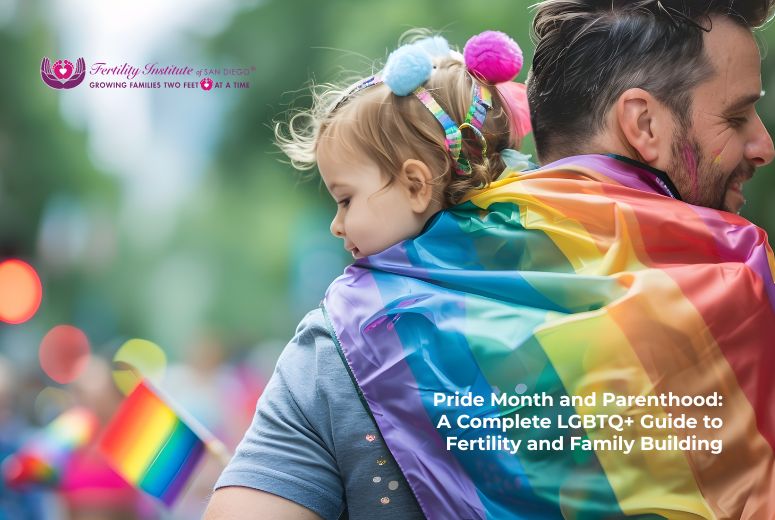
Pride Month is a celebration of identity, visibility, resilience, and community. It is also an important reminder that families are built in many different ways.
For LGBTQ+ individuals and couples, modern reproductive medicine has created an expanding landscape of opportunities that make parenthood increasingly accessible, personalized, and medically sophisticated.
At the Fertility Institute of San Diego, inclusive fertility care is not viewed as a niche service. It is a core part of compassionate fertility care.
“As reproductive medicine evolves, fertility care should evolve with it. LGBTQ+ individuals and couples deserve fertility care that is affirming, transparent, and individualized from beginning to end.”
Dr. Minoos Hosseinzadeh
There Is No One “Right” Way to Build a Family
LGBTQ family building is deeply personal.
- Reproductive anatomy and fertility health
- Relationship structure
- Genetic goals
- Age and ovarian reserve
- Budget and timeline
- Legal planning considerations
- Emotional readiness
Fertility Options for Lesbian Couples
IUI With Donor Sperm
For many lesbian couples, intrauterine insemination (IUI) is often the first fertility treatment explored.
- Healthy ovarian reserve
- Open fallopian tubes
- Regular ovulation
- No major infertility factors
IVF With Donor Sperm
IVF for LGBTQ individuals offers greater control over embryo development and reproductive planning.
- Higher pregnancy success rates
- Embryo genetic testing
- Gender selection
- Fertility preservation opportunities
- Greater scheduling flexibility
- Single embryo transfer planning
Reciprocal IVF Explained
Reciprocal IVF allows one partner to provide eggs while the other partner carries the pregnancy.
“Reciprocal IVF can be profoundly connective for couples. It allows both partners to experience different dimensions of parenthood together.”
Dr. Hosseinzadeh
Fertility Options for Gay Male Couples
Egg Donation + Gestational Surrogacy
- Selecting an egg donor
- Creating embryos through IVF
- Working with a gestational surrogate
- Donor medical history
- Genetic background
- Educational profile
- Personal characteristics
- Fresh vs frozen donor eggs
Choosing Between One or Both Genetic Parents
Some couples choose embryos from one partner only, while others fertilize eggs using sperm from both intended parents.
Fertility Options for Transgender and Nonbinary Individuals
- Egg freezing
- Sperm freezing
- Embryo freezing
- IVF after transition
- Fertility preservation before hormone therapy
“Every patient deserves to feel seen and respected throughout fertility treatment. Inclusive fertility care begins with listening carefully to each individual’s goals and experiences.”
Dr. Hosseinzadeh
Single LGBTQ+ Individuals Building Families
- Donor sperm with IUI or IVF
- Egg donation and surrogacy
- Fertility preservation for future parenthood
- Embryo banking
Understanding Egg Donation and Surrogacy
Gestational Carrier
A gestational carrier has no genetic connection to the child.
Traditional Surrogate
A traditional surrogate uses her own egg and carries the pregnancy. This pathway is less common today.
- Legal coordination
- Psychological screening
- Medical evaluations
- Embryo transfer planning
- Insurance considerations
Why California Is a Leading State for LGBTQ+ Family Building
- Established parentage protections
- LGBTQ+-inclusive reproductive laws
- Advanced fertility infrastructure
- Experienced surrogacy professionals
- Strong donor and fertility networks
Emotional Planning Is Just As Important As Medical Planning
- Decision fatigue
- Financial stress
- Relationship dynamics
- Disclosure conversations
- Timeline uncertainty
Precision IVF and Advanced Embryo Selection at FISD
The Fertility Institute of San Diego is currently the only clinic in San Diego that includes AI-assisted EmbryoScope technology with Chloe AI as part of every IVF cycle.
- Donor egg IVF
- Surrogacy cycles
- Single embryo transfer planning
- Embryo selection optimization
Questions to Ask When Choosing an LGBTQ+ Fertility Clinic
- Does the clinic regularly work with LGBTQ families?
- Is the communication inclusive and affirming?
- Does the clinic coordinate donor and surrogacy logistics?
- What IVF laboratory technologies are available?
- Are legal referrals and educational resources provided?
- Is care personalized from consultation through treatment?
FAQ
What fertility options are available for LGBTQ couples?
LGBTQ fertility options may include IUI, IVF, reciprocal IVF, donor sperm, donor eggs, gestational surrogacy, embryo freezing, and fertility preservation.
Can gay male couples have biological children?
Yes. Gay male couples can have biological children using donor eggs, IVF, and gestational surrogacy.
What is reciprocal IVF?
Reciprocal IVF allows one partner to provide eggs while the other partner carries the pregnancy.
Is surrogacy legal in California for LGBTQ couples?
Yes. California is considered one of the most LGBTQ-friendly states for gestational surrogacy and reproductive law protections.
Can transgender individuals preserve fertility?
Yes. Many transgender individuals preserve fertility through egg freezing, sperm freezing, or embryo freezing before transition-related treatment.
What is the best fertility treatment for lesbian couples?
The best treatment depends on reproductive health, age, and family-building goals. Common pathways include IUI, IVF, and reciprocal IVF.
Why is California popular for LGBTQ family building?
California offers supportive legal protections, advanced fertility clinics, experienced surrogacy professionals, and established donor programs.
Pride Month Is About Visibility Including Family Building
Modern families are beautifully diverse. Pride Month reminds us that visibility matters, especially in healthcare spaces where patients deserve clarity, support, and dignity.
“There is no universal blueprint for parenthood, and that is what makes every story meaningful.”
Dr. Hosseinzadeh
If you’re ready to start your fertility journey, please book a complimentary virtual consultation with Dr. Hosseinzadeh to discuss fertility options or any other reproductive healthcare questions.