

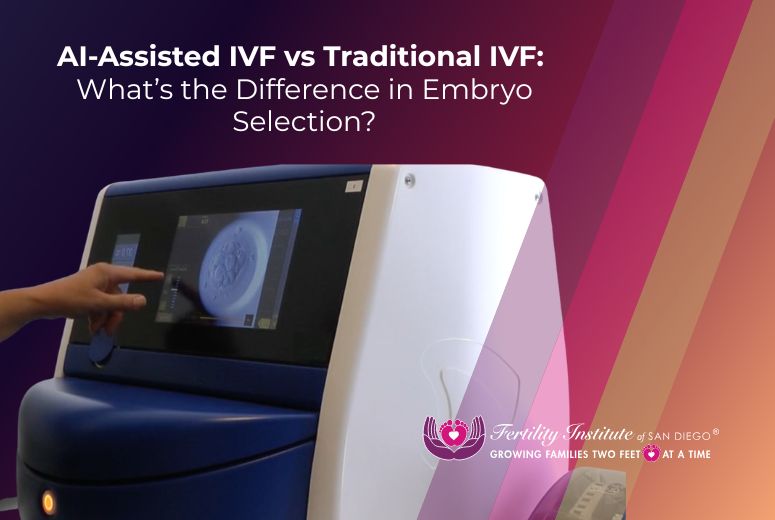
AI-Assisted IVF vs Traditional IVF: What’s the Difference in Embryo Selection?
Choosing the right embryo is one of the most consequential decisions in any IVF journey. For many patients exploring IVF San Diego options, the question is no longer just whether IVF works, but how embryos are selected and whether newer technologies can improve that decision.
The comparison between AI-assisted IVF vs traditional IVF centers on one critical shift: moving from observational judgment to data-supported analysis. Understanding this distinction helps patients make informed decisions about their treatment pathway.
Why Embryo Selection Is One of the Most Important Steps in IVF
During an IVF cycle, multiple embryos are typically created. However, not all embryos carry the same implantation potential. During the process of embryo selection IVF aims to identify the embryo most likely to result in a healthy pregnancy.
This decision impacts:
- Overall success rates
- The likelihood of a successful single embryo transfer
- The need for repeated cycles
- Emotional and financial burden
“Embryo selection is where science and judgment intersect. Our goal is to choose the embryo with the highest developmental potential while minimizing unnecessary interventions.”
Dr. Minoos Hosseinzadeh
How Traditional IVF Embryo Selection Works
Traditional embryo selection IVF relies on periodic visual assessments. Embryos are removed from the incubator at specific intervals and evaluated under a microscope.
Embryologists assess:
- Cell symmetry
- Degree of fragmentation
- Rate of cell division
- Blastocyst morphology
These observations form the basis of the embryo grading system used in most IVF laboratory standards.
The limitation is inherent in the method itself. Each evaluation is a snapshot in time. Subtle developmental dynamics between these checkpoints may go unnoticed.
The Challenge of Subjectivity in Traditional Embryo Grading
Even in highly experienced hands, traditional grading introduces variability. Two embryologists may interpret the same embryo slightly differently based on visual cues.
Key challenges include:
- Limited observation windows
- Human interpretation variability
- Missed morphokinetic patterns
- Inconsistent embryo grading accuracy IVF
This does not diminish expertise. Rather, it highlights the constraints of snapshot-based evaluation.
“Traditional embryo grading is highly skilled, but it is still interpretive. We are working with limited time points and visual impressions.”
Dr. Minoos Hosseinzadeh
What Is AI-Assisted IVF?
AI-assisted IVF introduces a different paradigm. It combines time-lapse embryo monitoring with artificial intelligence algorithms designed to analyze embryo development patterns.
Instead of relying solely on periodic observation, embryos are continuously monitored inside a controlled incubator environment.
This approach forms the foundation of precision IVF, where decision-making is supported by structured data rather than isolated observations.
How AI-Assisted Embryo Selection Works
Continuous Time-Lapse Monitoring
Using systems such as EmbryoScope vs standard IVF setups, images are captured every few minutes. This creates a continuous developmental record.
Advantages include:
- Thousands of data points per embryo
- No disturbance from incubator removal
- Full visibility of embryo development tracking
AI Pattern Recognition with Chloe AI
AI embryo selection tools like Chloe AI analyze morphokinetics, which refers to the timing and sequence of cell divisions.
The system evaluates:
- Cleavage timing
- Division symmetry
- Developmental milestones
- Patterns linked to viability
This creates an additional layer of insight beyond visual grading.
“AI does not replace embryologists. It enhances our ability to interpret embryo development with greater consistency.”
Dr. Minoos Hosseinzadeh
Objective vs Subjective Embryo Selection
Traditional IVF:
- Snapshot observations
- Subjective interpretation
- Limited data points
- Embryo removed from incubator
- Variability between embryologists
AI-assisted IVF:
- Continuous monitoring
- Data-supported analysis
- Thousands of data points
- No disturbance to embryo environment
- Greater consistency in evaluation
The key insight is not that AI replaces expertise, but that it reduces variability and augments clinical judgment.
Precision IVF at Fertility Institute of San Diego
At the Fertility Institute of San Diego, AI-assisted EmbryoScope technology with Chloe AI is integrated into every IVF cycle.
This means:
- AI embryo selection is not an optional add-on
- Every patient benefits from continuous monitoring
- Embryo selection IVF decisions are data-informed
This approach aligns with the broader philosophy of precision IVF, where consistency and objectivity are prioritized alongside individualized care.
Does AI-Assisted IVF Improve Outcomes?
A common question is whether AI improves embryo selection enough to impact success rates.
Current evidence suggests:
- Improved confidence in embryo selection
- Better support for single embryo transfer
- Reduced likelihood of unnecessary transfers
- More standardized embryo grading accuracy IVF
However, it is important to remain clinically grounded.
“Technology supports decision-making, but outcomes still depend on the entire ecosystem of care.”
Dr. Minoos Hosseinzadeh
Who May Benefit Most From AI-Assisted IVF?
While AI-assisted IVF can benefit many patients, certain groups may find it particularly valuable:
- Patients over 35
- Individuals with limited embryo numbers
- Previous IVF failure cases
- Donor egg IVF cycles
- Surrogacy IVF cycles
- Patients seeking single embryo transfer
Technology Is One Piece of the IVF Equation
It is essential to recognize that IVF success is multifactorial.
Key contributing elements include:
- Reproductive endocrinologist expertise
- Laboratory conditions and protocols
- Genetic testing such as PGT embryo testing
- Patient-specific factors
AI-assisted IVF is a powerful tool, but it operates within a broader clinical framework.
Choosing the Right IVF Approach for You
Patients evaluating which IVF method is better should focus on how decisions are made, not just what technology is used.
Consider asking:
- How are embryos selected in IVF?
- Is embryo grading subjective or standardized?
- What lab technology is used?
- How is consistency ensured across cycles?
Personalized care remains the most important factor.
FAQ Section
What is the difference between AI IVF and traditional IVF?
Traditional IVF relies on visual grading at specific time points, while AI-assisted IVF uses continuous monitoring and data analysis to support embryo selection.
Is embryo grading subjective?
Yes. Traditional embryo grading involves expert interpretation, which can vary between embryologists.
How does AI help embryo selection?
AI analyzes developmental timing and patterns, providing additional data that supports more consistent decision-making.
Does AI increase IVF success rates?
AI improves selection confidence and consistency, but outcomes depend on multiple clinical factors.
Is AI-assisted IVF available in San Diego?
Yes. Fertility Institute of San Diego integrates AI-assisted embryo selection into every IVF cycle.
Should I choose IVF based on technology?
Technology is important, but overall care quality and physician expertise are equally critical.
What is Chloe AI in IVF?
Chloe AI is an artificial intelligence system that analyzes embryo development patterns to assist in embryo selection.
If you’re ready to start your fertility journey
If you’re ready to start your fertility journey, please book a complimentary virtual consultation with Dr. Hosseinzadeh, to go over fertility options or any other reproductive healthcare questions.