


When IVF Doesn’t Work: Understanding the Emotional and Medical Reality
Experiencing failed IVF cycles can feel disorienting. Patients often move from hope to confusion, asking a deeply personal question: why IVF fails despite careful planning.
At a clinical level, IVF is not a singular event but a sequence of biological variables interacting under controlled conditions. One cycle rarely provides complete answers. It offers signals, patterns, and partial data.
“Each IVF cycle tells us something valuable. Our responsibility is to interpret that information carefully and refine the next step with greater precision.”
Dr. Minoos Hosseinzadeh
The reframing matters. IVF after failed cycles is not about repeating the same process. It is about improving decision-making based on what has already been observed.
Why IVF Cycles Fail
Understanding repeated IVF failure causes requires a multidimensional perspective. IVF outcomes are influenced by several interdependent factors.
Common Causes of Failed IVF Cycles
- Embryo quality and developmental competence
- Chromosomal abnormalities affecting viability
- Implantation failure including uterine receptivity issues
- Sperm DNA fragmentation or male factor infertility
- Laboratory variability in culture conditions and assessment
- Endometrial timing and hormonal synchronization
No single variable explains every outcome. More often, failed IVF cycles reflect a combination of subtle inefficiencies rather than a single identifiable issue.
The Missing Piece: Decision-Making Under Uncertainty
A critical yet often overlooked factor in IVF after failed cycles is how decisions are made inside the lab.
Embryos may appear morphologically similar at specific observation points. Yet their developmental trajectories can differ significantly.
Traditional workflows rely on intermittent snapshots. This creates an inherent limitation: embryologists must make high-stakes decisions based on incomplete datasets.
This is where the concept of data-driven IVF decisions becomes clinically relevant.
How Embryos Are Traditionally Selected
Embryo selection has historically been based on morphology.
This includes:
- Cell symmetry
- Fragmentation levels
- Blastocyst expansion
- Inner cell mass and trophectoderm grading
While this approach remains foundational, it is inherently subjective.
Two experienced embryologists may prioritize different embryos based on interpretation. In first-time cycles, this variability may be acceptable. In failed IVF cycles, it becomes more consequential.
Why Subjectivity Matters More After Failed Cycles
After one or more unsuccessful attempts, small differences begin to matter more.
Repeating the same selection methodology can lead to similar outcomes.
This is particularly relevant in cases involving:
- Limited embryo cohorts
- Unexplained implantation failure
- Inconsistent embryo development
“After prior IVF attempts, our focus shifts from simply selecting embryos to refining how we evaluate them. The goal is to reduce uncertainty wherever possible.”
Dr. Hosseinzadeh
What Is AI-Guided Embryo Selection
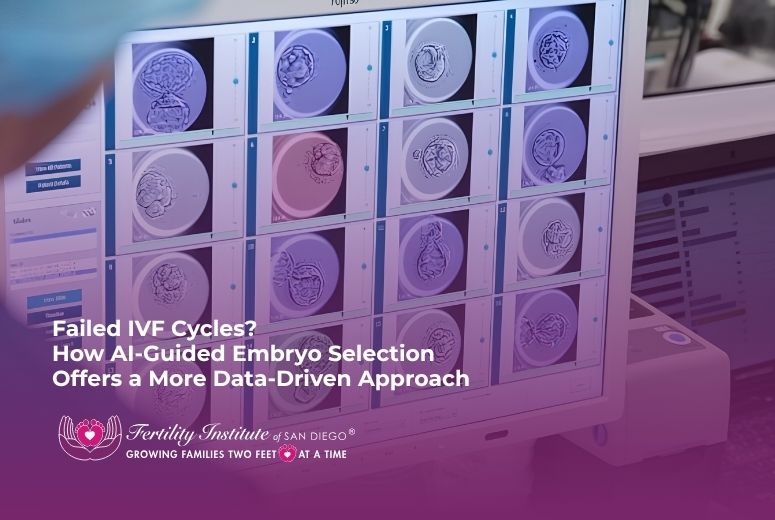
AI embryo selection introduces an additional analytical layer into the IVF process.
It combines:
- Time-lapse imaging that continuously monitors embryo development
- Algorithmic analysis of morphokinetics, which tracks the timing of cell divisions
Instead of isolated observations, embryos are evaluated as dynamic systems evolving over time.
This shift allows clinicians to better understand embryo selection after failed IVF in a more comprehensive way.
How Chloe AI Adds a Data-Driven Layer
At the Fertility Institute of San Diego, AI-guided analysis is powered by Chloe AI embryo selection, integrated within the EmbryoScope platform.
Chloe AI evaluates:
- Cleavage timing patterns
- Developmental synchronicity
- Subtle kinetic irregularities not visible to the human eye
It processes significantly more data points than manual observation alone.
“AI does not replace clinical judgment. It enhances it by providing objective insights that support more consistent decision-making.”
Dr. Hosseinzadeh
This is particularly valuable in IVF success after multiple failures, where prior outcomes may not clearly indicate the optimal path forward.
From Subjective to More Objective Decision-Making
The primary advantage of AI embryo selection is standardization.
It helps:
- Reduce inter-observer variability
- Create consistency across embryo evaluations
- Support prioritization based on measurable developmental patterns
This transition toward data-driven IVF decisions is not about removing expertise. It is about augmenting it with structured analytical support.
Precision IVF at Fertility Institute of San Diego
The Fertility Institute of San Diego integrates AI-guided embryo assessment as part of its clinical framework.
Fertility Institute of San Diego is currently the only clinic in San Diego that includes AI-assisted EmbryoScope technology with Chloe AI as part of every IVF cycle.
This approach is embedded within what the clinic defines as precision IVF:
- AI analysis included in all IVF cycles
- Not offered as an optional add-on
- Applied particularly in:
- Failed IVF cycles
- Limited embryo scenarios
- Cases with unclear prior outcomes
This integration aligns laboratory insights with individualized patient care.
Can AI Improve Outcomes After Failed IVF
A common question is whether AI embryo selection can directly improve success rates.
The answer requires nuance.
AI can:
- Improve consistency in embryo ranking
- Support single embryo transfer strategies
- Identify embryos with stronger developmental signals
However:
- It does not guarantee pregnancy
- It does not replace uterine or genetic evaluations
“Technology gives us better clarity. But IVF remains a biological process. Our role is to align the best available data with each patient’s unique physiology.”
Dr. Hosseinzadeh
What Else Should Be Evaluated After Failed IVF
Diagnostic Considerations
- PGT embryo testing for chromosomal analysis
- Uterine cavity evaluation
- Endometrium testing
- Sperm DNA fragmentation analysis
Treatment Adjustments
- Protocol modification
- Hormonal optimization
- Consideration of donor egg IVF in select cases
IVF optimization strategies must address both embryo quality and implantation conditions.
A More Strategic Approach Moving Forward
Each IVF cycle contributes data.
The objective is not repetition, but refinement.
A strategic approach to IVF after failed cycles combines:
- Clinical expertise
- Advanced laboratory technology
- Individualized treatment planning
This iterative model transforms uncertainty into actionable insight.
Choosing the Right Clinic After Failed IVF
Selecting a provider after failed IVF cycles requires careful evaluation.
Key factors include:
- Transparency in explaining prior outcomes
- Access to advanced lab technologies
- Experience with complex or repeated failure cases
- Willingness to adapt protocols
A strong fertility clinic San Diego should demonstrate both technical capability and clinical adaptability.
FAQ
Why do IVF cycles fail?
IVF cycles fail due to a combination of factors including embryo quality, chromosomal abnormalities, uterine conditions, and sperm health. It is rarely a single cause.
What should I do after failed IVF?
After failed IVF, a detailed review of the cycle is essential. This may include additional testing, protocol changes, and considering technologies like AI embryo selection.
Can AI improve IVF outcomes?
AI can improve embryo selection consistency and decision-making. It supports better prioritization but does not guarantee success.
How are embryos selected after failed IVF?
Embryos are selected using morphology, time-lapse monitoring, and increasingly AI analysis to assess developmental patterns more accurately.
What is Chloe AI in IVF?
Chloe AI is an advanced tool that analyzes embryo development timing and patterns to support more objective selection decisions.
Is AI-assisted IVF available in San Diego?
Yes, AI-assisted embryo selection is available at Fertility Institute of San Diego as part of their standard IVF process.
Should I change clinics after failed IVF?
Not always, but if there is limited transparency, lack of advanced technology, or no change in strategy, seeking a second opinion may be beneficial.