

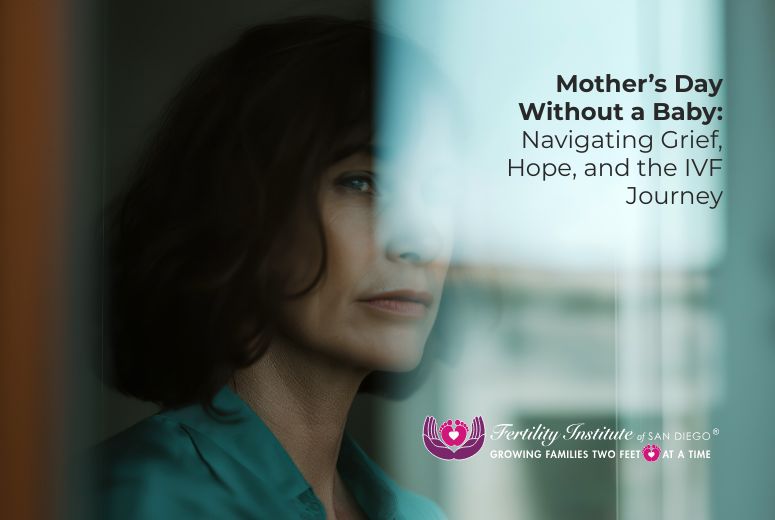
Mother’s Day infertility can feel like a quiet paradox. While the world celebrates motherhood, many individuals find themselves navigating an internal landscape shaped by longing, resilience, and deeply personal loss. If you are moving through an IVF journey, this day may carry emotional weight that is difficult to articulate.
You may feel joy for others while simultaneously experiencing infertility grief that feels invisible yet profound.
At the Fertility Institute of San Diego, patients are often reminded that this duality is not only normal but deeply human.
When Mother’s Day Feels Different
For many, Mother’s Day without a baby can create a sense of displacement.
You may feel:
- A subtle detachment during celebrations
- Emotional fatigue from repeated well-meaning conversations
- A quiet ache that contrasts with external joy
This is a recognized emotional response within the IVF journey emotions spectrum. The experience is not linear, nor is it predictable.
“Many of our patients express that Mother’s Day brings a mix of tenderness and grief. It is important to recognize that both can coexist without diminishing each other.”
Dr. Minoos Hosseinzadeh
The Quiet Grief of the Fertility Journey
Infertility grief is often described as ambiguous loss. It lacks clear closure, making it uniquely challenging.
Unlike conventional grief, there is no defined endpoint.
Within the IVF emotional journey, patients encounter:
- Cycles of anticipation followed by uncertainty
- Emotional investment in each stage of treatment
- Repeated recalibration of expectations
This cumulative emotional layering can lead to what psychologists refer to as anticipatory mourning, where hope and fear coexist in delicate tension.
You Can Hold Grief and Hope at the Same Time
One of the most important psychological reframes in coping with Mother’s Day infertility is understanding that grief and hope are not mutually exclusive.
- Grief reflects the depth of your desire
- Hope reflects the continuation of your journey
Holding both simultaneously is not contradictory. It is a form of emotional resilience.
“Hope during IVF treatment does not erase the pain patients feel. It simply allows space for the future while honoring the present.”
Dr. Minoos Hosseinzadeh
Why IVF Is as Emotional as It Is Medical
The IVF journey emotions are shaped not only by medical processes but by temporal uncertainty.
Key emotional pressure points include:
- Waiting for follicular development
- Fertilization updates
- Embryo selection decisions
- Implantation and early pregnancy monitoring
Each phase introduces a period of suspended certainty, which can amplify anxiety and emotional fatigue.
At a fertility clinic San Diego patients trust, care must extend beyond laboratory precision. Emotional regulation, psychological support, and individualized pacing are equally critical.
The Role of Support During the IVF Journey
Infertility and grief support systems can significantly influence emotional outcomes.
Effective support structures include:
- Partner communication grounded in empathy
- Trusted friends who respect emotional boundaries
- Fertility-informed counseling
- Peer communities experiencing similar journeys
Seeking IVF emotional journey support is not a sign of vulnerability. It is a strategic step toward maintaining mental equilibrium.
Taking Care of Yourself on Mother’s Day
Knowing how to handle holidays during infertility requires intentional self-care.
Consider the following strategies:
- Set boundaries
- Create personal rituals
- Limit social exposure
- Communicate needs clearly
These actions reinforce autonomy during a time that may otherwise feel externally dictated.
Redefining What This Day Means for You
Mother’s Day infertility does not have to be defined solely by absence. It can also be reframed as recognition.
- Recognition of effort
- Recognition of persistence
- Recognition of emotional endurance
You are not outside of motherhood. You are in the process of becoming.
Where Medicine and Compassion Meet
Fertility care is most effective when it integrates clinical excellence with emotional intelligence.
At the Fertility Institute of San Diego, care is designed to support both the medical and emotional aspects of the fertility journey.
With advancements such as precision IVF and AI-assisted embryo assessment, patients benefit from enhanced clinical insight. However, the human element remains central.
“Every patient’s journey is deeply personal. Our role is to guide them with both scientific precision and genuine compassion.”
Dr. Minoos Hosseinzadeh
Your Story Is Still Being Written
The IVF journey is not defined by a single moment or outcome. It is an evolving narrative.
Even when progress feels slow or uncertain, each step contributes to a broader trajectory.
Hope during IVF treatment is not about certainty. It is about continuation.
You Are Not Alone
Feeling left out on Mother’s Day is more common than many realize during IVF treatment.
Infertility mental health support exists in many forms:
- Clinical counseling
- Support groups
- Fertility-focused communities
Reaching out can transform isolation into connection.
FAQs
How do I cope with infertility on Mother’s Day?
Focus on self-directed care. Set boundaries, limit exposure to triggering environments, and create meaningful personal rituals.
Is it normal to feel sad on Mother’s Day during IVF?
Yes. IVF journey emotions often include sadness, grief, and reflection, especially during symbolic occasions.
How can I protect my mental health during fertility treatment?
Engage in structured support such as counseling, maintain open communication, prioritize rest and emotional regulation.
Should I avoid Mother’s Day events?
If events feel overwhelming, it is appropriate to opt out. Your emotional wellbeing is a valid priority.