

Embryo selection is one of the most important stages of in vitro fertilization. After fertilization, embryologists carefully evaluate developing embryos to understand their progression and determine which embryo or embryos may be appropriate for transfer or cryopreservation.
Traditionally, embryo assessment has relied heavily on observations made at specific developmental checkpoints. Today, technologies including EmbryoScope time-lapse monitoring and AI-assisted embryo assessment can provide additional information about embryo development.
Although the term AI embryo selection is commonly used, the technology is more accurately understood as AI-assisted embryo assessment. Artificial intelligence does not independently choose an embryo or make a clinical decision. Instead, it can provide additional information that embryologists and physicians consider alongside laboratory observations and the patient’s broader clinical picture.
At Fertility Institute of San Diego, our Precision IVF approach combines EmbryoScope time-lapse monitoring with Chloe AI-assisted embryo assessment, embryology expertise, and individualized physician interpretation.
“Technology can give us additional information about an embryo’s development, but that information must always be interpreted within the complete clinical picture of the patient.”
Dr. Minoos Hosseinzadeh
How Are Embryos Traditionally Selected for IVF?
Traditional embryo assessment evaluates characteristics of an embryo at specific stages of development. This is often described as morphological assessment.
Embryologists may examine factors such as cell number, cellular symmetry, fragmentation, developmental progression, blastocyst expansion, and other morphological characteristics.
These observations provide valuable information, but embryo development is dynamic. An embryo continues to change between individual assessment points. Also, assessments made by a single embryologist can be subjective with different grades given by different embryologists for the same embryo.
Time-lapse embryo monitoring provides another way to observe this developmental process by creating a sequence of images over time.
What Is an EmbryoScope?
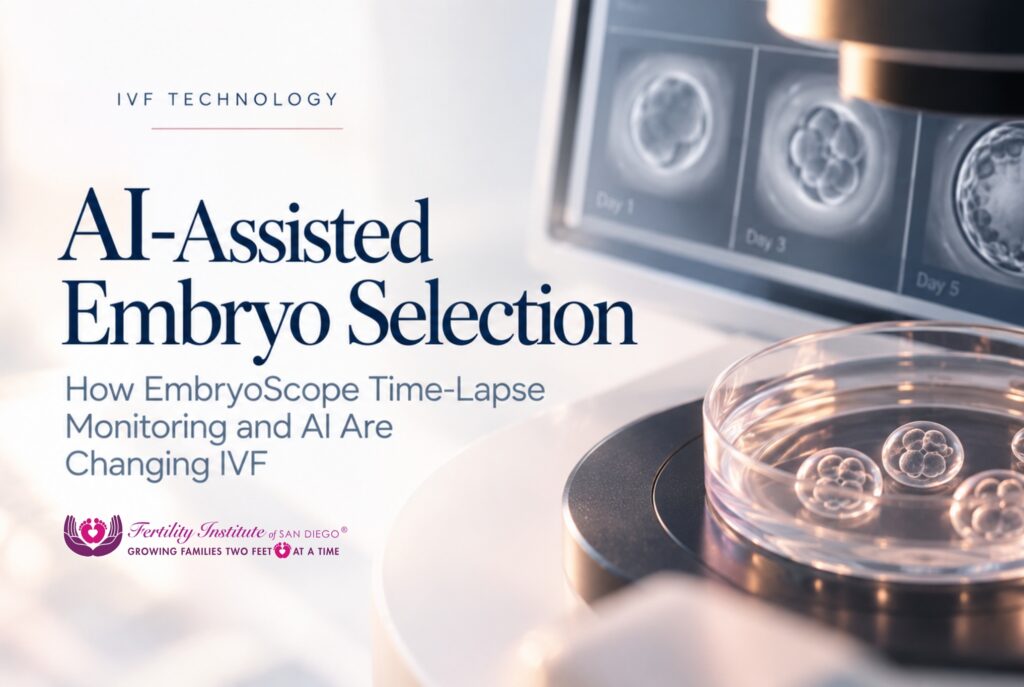
An EmbryoScope is an embryo incubation system equipped with time-lapse imaging technology. During embryo culture, images are captured every 10 minutes thus creating a continuous developmental video record for each embryo.
Rather than relying solely on individual snapshots, embryologists can review how an embryo progressed over time.
This is known as time-lapse imaging in IVF.
Importantly, the value of time-lapse monitoring is not simply that more images are available. The developmental chronology can provide information about the timing and pattern of biological events occurring during embryo culture.
What Does EmbryoScope See That Traditional Observation May Not?
During the first several days following fertilization, embryos undergo a succession of cellular divisions and developmental transitions.
Time-lapse embryo monitoring can document characteristics such as:
- Timing of cell divisions
- Cleavage patterns
- Progression through developmental stages
- Compaction
- Development toward the blastocyst stage
- Other observable morphokinetic characteristics
The term morphokinetics refers to the relationship between embryo morphology and the timing of developmental events.
Time-lapse technology therefore provides a more continuous developmental chronology rather than relying exclusively on observations made at isolated points.
EmbryoScope also allows developmental imaging to occur within the incubation environment without removing embryos specifically for each time-lapse image.
“Embryo development is a process rather than a single moment. Time-lapse monitoring gives the laboratory another way to observe that process and evaluate the developmental history of an embryo.”
Dr. Minoos Hosseinzadeh
Where Does Artificial Intelligence Enter the Process?
It is important not to use EmbryoScope and artificial intelligence interchangeably. They represent separate but complementary components of advanced embryo assessment.
EmbryoScope provides embryo culture, time-lapse imaging, and developmental information.
AI-assisted assessment analyzes embryo images and developmental data to identify patterns that may provide additional information during embryo evaluation.
Embryologists and physicians interpret the available information within the patient’s individual treatment context and make clinical decisions.
At Fertility Institute of San Diego, Chloe AI-assisted embryo assessment is incorporated into the Precision IVF approach alongside EmbryoScope time-lapse monitoring.
Chloe functions as a decision-support tool. It does not replace the embryologist, reproductive endocrinologist, or individualized medical decision-making.
Can AI Choose the Best Embryo for IVF?
Patients researching AI embryo selection often encounter the idea that artificial intelligence can simply identify the “best” embryo.
The reality is considerably more nuanced.
AI-assisted analysis can identify patterns within embryo images and developmental data that may provide additional information during embryo assessment. This information can then be considered alongside morphology and other clinically relevant factors.
But embryo development is only one part of the reproductive process.
Age, embryo genetics, uterine factors, underlying reproductive conditions, laboratory factors, and other biological variables may all influence treatment outcomes.
For this reason, AI-assisted embryo selection should be viewed as decision support rather than an automated prediction of which embryo will result in a healthy pregnancy.
Is AI Embryo Assessment the Same as PGT-A?
No. This is an important distinction for patients considering IVF.
AI-assisted embryo assessment and PGT-A, or preimplantation genetic testing for aneuploidy, evaluate different types of information.
AI and time-lapse assessment evaluate imaging and developmental characteristics.
PGT-A involves testing biopsied embryo material to assess chromosome copy number.
Time-lapse imaging or AI analysis should not be presented as proof that an embryo is chromosomally normal, nor should AI-assisted assessment be considered a substitute for genetic testing when PGT-A is clinically appropriate.
Whether PGT-A should be considered is an individualized clinical decision that should be discussed with a reproductive endocrinologist.
Can AI Predict Which Embryo Will Implant?
AI-assisted analysis can identify patterns within embryo images and developmental information. However, identifying developmental patterns is not equivalent to knowing what will happen after an embryo is transferred.
Implantation is a multifactorial biological process.
Embryo characteristics are important, but successful implantation also involves factors beyond image analysis alone.
For that reason, one principle should remain clear:
AI can support embryo assessment and prioritization. It cannot guarantee implantation, pregnancy, or live birth.
The same caution applies to time-lapse monitoring. Current research continues to evaluate how time-lapse technologies and AI-assisted embryo assessment may contribute to clinical outcomes, and evidence should not be interpreted as establishing guaranteed improvements in IVF success.
Precision IVF at Fertility Institute of San Diego
For patients researching AI-assisted IVF in San Diego, the important question is not simply whether advanced technology is available. It is how that technology is integrated into individualized fertility care.
At Fertility Institute of San Diego in La Jolla, Precision IVF brings together:
- EmbryoScope time-lapse monitoring
- Chloe AI-assisted embryo assessment
- Detailed embryology evaluation
- Individual patient characteristics
- Physician interpretation and treatment planning
The objective is not to replace clinical expertise with an algorithm. Instead, these technologies provide additional information that may be considered when evaluating embryo development and making treatment decisions.
“Precision IVF is about bringing multiple sources of information together and applying them thoughtfully to the individual patient. AI is one component of that process, not a substitute for personalized medicine.”
Dr. Minoos Hosseinzadeh
As a specialized private fertility practice, Fertility Institute of San Diego provides individualized reproductive care with Dr. Hosseinzadeh throughout the patient’s treatment journey.
Frequently Asked Questions About AI Embryo Selection
What is AI-assisted embryo selection?
AI-assisted embryo selection uses computational analysis of embryo images and developmental information to provide additional data that may support embryo assessment. Clinical decisions remain with the embryology and medical team.
How does EmbryoScope time-lapse monitoring work?
EmbryoScope captures images of developing embryos at regular intervals during culture, creating a developmental timeline that can be reviewed by the embryology team.
Does EmbryoScope remove embryos from the incubator for evaluation?
Time-lapse imaging occurs within the incubation environment, so embryos do not need to be removed specifically for each time-lapse image.
Is AI embryo grading better than traditional embryo grading?
AI-assisted assessment provides another layer of information rather than simply replacing traditional morphological assessment. Available information can be interpreted together by the clinical team.
Can AI tell whether an embryo is chromosomally normal?
No. AI-assisted imaging assessment does not establish an embryo’s chromosome status and is not equivalent to PGT-A.
Does EmbryoScope improve IVF success?
Time-lapse monitoring provides additional developmental information, but evidence regarding improvements in clinical outcomes remains an area of continuing research. It should not be presented as guaranteeing greater IVF success.
Does AI-assisted IVF guarantee better IVF success rates?
No. AI-assisted assessment may provide additional information for embryo evaluation, but it cannot guarantee implantation, pregnancy, or live birth.
A More Detailed View of Embryo Development
The progression from periodic embryo observation to time-lapse embryo monitoring and AI-assisted analysis represents an important development in modern embryology.
It also illustrates an important principle of Precision IVF: more information can support more detailed assessment, but technology does not eliminate biological uncertainty.
For patients exploring AI embryo selection in San Diego, EmbryoScope IVF, advanced embryo assessment, or fertility treatment following a previous unsuccessful IVF cycle, an individualized consultation can help determine how these technologies may fit into a broader treatment strategy.
If you’re ready to start your fertility journey, please book a complimentary virtual consultation with Dr. Hosseinzadeh to go over fertility options or any other reproductive healthcare questions.