

For decades, millions of women have known one of the most common endocrine conditions affecting reproductive health as polycystic ovary syndrome, or PCOS. In 2026, that changed.
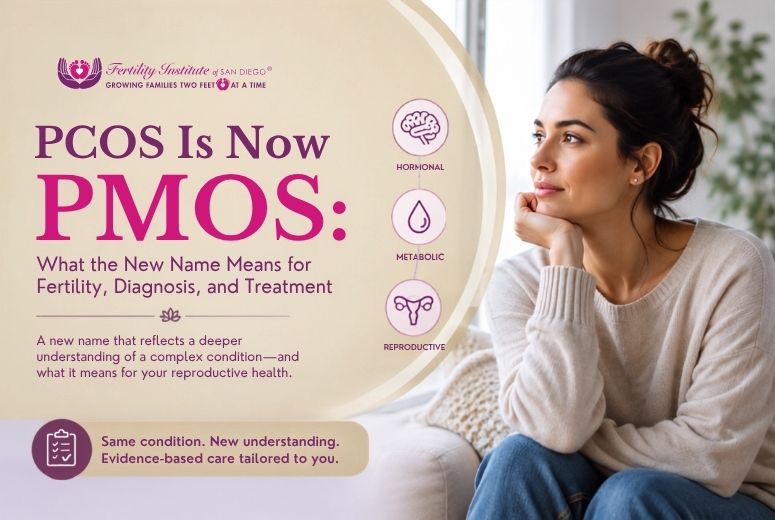
PCOS is now PMOS, short for Polyendocrine Metabolic Ovarian Syndrome.
The new terminology is more than a linguistic update. It reflects a more accurate understanding of a complex condition that can influence hormones, metabolism, ovulation, menstrual cycles, and fertility.
For women trying to conceive, however, the announcement may create understandable questions. Has the condition itself changed? Does an existing PCOS diagnosis still apply? Does PMOS fertility treatment differ from previous PCOS treatment?
The most important point is reassuring: the name has changed, but the condition did not suddenly become a different disease. Existing diagnoses remain relevant, and current evidence-based diagnostic and treatment recommendations remain in place during the terminology transition.
“For patients who have spent years understanding their diagnosis as PCOS, the transition to PMOS should not create additional anxiety. What matters clinically is understanding how the condition is affecting that individual patient, particularly her ovulation, metabolic health, and reproductive goals.”
Dr. Minoos Hosseinzadeh, Founder and Medical Director, Fertility Institute of San Diego
Why Was PCOS Renamed PMOS?
The term “polycystic ovary syndrome” has long been problematic because it places disproportionate emphasis on the ovaries and, particularly, on “cysts.”
PMOS is not fundamentally a cyst disorder.
The international initiative behind the change involved patients, clinicians, researchers, and professional organizations worldwide. The new name, Polyendocrine Metabolic Ovarian Syndrome, better represents the condition’s heterogeneous endocrine, metabolic, and reproductive manifestations.
The word polyendocrine recognizes that multiple hormonal pathways can be involved. Metabolic acknowledges features such as insulin resistance and increased metabolic risk. Ovarian retains the important reproductive component without suggesting that ovarian cysts define the condition.
VISUAL CALLOUT: PCOS vs. PMOS
OLD: Polycystic Ovary Syndrome (PCOS)
Focus could misleadingly suggest ovarian cysts are the defining feature.
NEW: Polyendocrine Metabolic Ovarian Syndrome (PMOS)
Reflects the broader endocrine, metabolic, and ovarian dimensions of the condition.
Does PMOS Mean You Have Ovarian Cysts?
No. This is one of the most important misconceptions the new terminology attempts to correct.
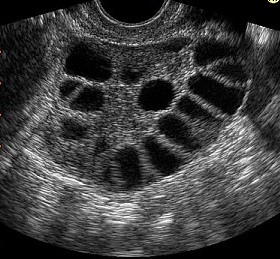
The ovarian appearance associated with PMOS involves an increased number of small follicles, not necessarily pathological ovarian cysts. Furthermore, a patient does not need to have polycystic ovarian morphology to meet diagnostic criteria in every clinical scenario.
This distinction matters because some women with irregular ovulation or androgen excess may have assumed they could not have PCOS because an ultrasound did not show “cysts.”
PMOS provides a more physiologically representative framework.
What Has Actually Changed?
Changed
The name: PCOS is now PMOS.
The clinical framing: The terminology better recognizes PMOS as a multisystem endocrine, metabolic, and reproductive condition rather than a disorder defined primarily by ovarian appearance.
Has Not Changed
Your previous diagnosis does not automatically become invalid.
The 2023 International Evidence-based Guideline recommendations remain applicable.
Current diagnostic and treatment recommendations remain in place during the terminology transition.
The updated international guideline specifically notes that its recommendations and content remain unchanged following the PMOS terminology update.
How Is PMOS Diagnosed?
For adults, current international guidance generally evaluates three principal characteristics:
- Clinical or biochemical hyperandrogenism, such as elevated androgen levels or signs of androgen excess
- Ovulatory dysfunction, often reflected by irregular or absent menstrual cycles
- Polycystic ovarian morphology identified through ultrasound or, in appropriate adults, assessment using anti-Müllerian hormone, or AMH
Other potential causes of these findings must also be excluded.
When irregular menstrual cycles and hyperandrogenism are both present, ultrasound or AMH may not be necessary to establish the diagnosis.
Diagnosis should therefore involve considerably more than looking at an ultrasound.
PMOS Symptoms and Signs
PMOS can present differently from one woman to another. Possible manifestations include:
- Irregular, infrequent, or absent menstrual periods
- Irregular ovulation or anovulation
- Difficulty becoming pregnant
- Elevated androgen levels
- Acne
- Excess facial or body hair
- Thinning scalp hair
- Metabolic abnormalities, including insulin resistance
- Changes in weight or difficulty with weight management
Not every patient experiences every feature, which is one reason individualized evaluation is important.
How Does PMOS Affect Fertility?
The connection between PMOS and infertility frequently centers on ovulation.
A predictable menstrual cycle usually involves coordinated hormonal signaling that allows a follicle to mature and release an egg. With PMOS, follicular development and ovulatory signaling may become dysregulated.
Some women ovulate inconsistently. Others experience prolonged periods of anovulation.
If an egg is not released regularly, opportunities for fertilization become less predictable or substantially less frequent.
However, PMOS does not mean pregnancy is impossible.
International fertility guidance specifically emphasizes that women with PMOS can often achieve pregnancy naturally or with fertility assistance.
“PMOS infertility is not one single fertility problem. One patient may primarily need help restoring predictable ovulation, while another may have additional factors involving age, sperm, tubal function, or ovarian reserve. Treatment should be based on the complete reproductive picture.”
Dr. Minoos Hosseinzadeh
PMOS, AMH, and Ovarian Reserve
PMOS is sometimes associated with higher AMH levels because patients may have a greater number of small developing follicles.
But a high AMH result should not automatically be interpreted as superior fertility.
Ovarian reserve and egg quality are different concepts. Egg quality remains strongly associated with maternal age, while AMH primarily provides information related to the available follicular pool and anticipated ovarian response.
This distinction becomes particularly important when planning fertility treatment.
Fertility Testing for Women With PMOS
A comprehensive fertility evaluation should look beyond the PMOS diagnosis itself.
Depending on the patient’s circumstances, evaluation may include menstrual and ovulation history, hormonal testing, ovarian reserve assessment, ultrasound, semen analysis for a male partner when applicable, and consideration of fallopian tube evaluation.
Age, previous pregnancies, duration of infertility, metabolic health, and previous fertility treatments can also influence the recommended strategy.
VISUAL: PMOS FERTILITY PATHWAY
PMOS Diagnosis or Symptoms
↓
Ovulation + Hormonal Evaluation
↓
Ovarian Reserve + Partner/Tubal Factors When Appropriate
↓
Individualized Fertility Plan
↓
Ovulation Induction / Timed Intercourse / IUI / IVF
Fertility Treatment for PMOS
There is no universal PMOS treatment protocol for every patient trying to conceive.
Ovulation Induction
For women whose primary fertility barrier is anovulation, medication may be used to encourage ovulation. Current international guidance recommends letrozole as first-line pharmacological ovulation induction treatment for women with anovulatory PMOS infertility when no other infertility factors are present.
Other medications may be appropriate depending on the patient’s circumstances.
IUI for Women With PMOS
Intrauterine insemination, or IUI, may be considered in selected cases, particularly when controlled ovulation induction is combined with strategically timed placement of prepared sperm.
Whether IUI is appropriate depends on the broader fertility evaluation.
IVF for Women With PMOS
IVF may become appropriate when simpler fertility treatments have been unsuccessful or when additional infertility factors make IVF clinically advantageous.
Women with PMOS can sometimes demonstrate a robust ovarian response to stimulation. This makes individualized medication dosing and careful monitoring particularly important because PMOS patients undergoing IVF can have an increased risk of ovarian hyperstimulation syndrome.
Modern IVF protocols provide strategies that can substantially reduce this risk.
Can You Get Pregnant Naturally With PMOS?
Yes. Some women with PMOS ovulate spontaneously and become pregnant without fertility treatment.
The difficulty is that irregular cycles can make ovulation harder to predict. A cycle lasting 40, 50, or more days may provide substantially fewer opportunities for conception over the course of a year than regular ovulatory cycles.
Women should not assume they need IVF simply because they have PMOS. Conversely, repeatedly waiting for unpredictable ovulation may not be appropriate for every patient, particularly when age or other fertility factors are relevant.
When Should You See a Fertility Specialist?
Women with PMOS or suspected PMOS may benefit from earlier reproductive evaluation when menstrual cycles are very irregular or absent, ovulation appears inconsistent, or there are additional fertility concerns.
Age matters as well.
Rather than viewing PMOS in isolation, a reproductive endocrinologist can assess how the condition interacts with ovarian reserve, reproductive age, sperm factors, tubal health, metabolic considerations, and the patient’s family-building timeline.
Frequently Asked Questions About PMOS and Fertility
Is PCOS officially called PMOS now?
Yes. In May 2026, Polyendocrine Metabolic Ovarian Syndrome, or PMOS, became the new name for the condition previously known as Polycystic Ovary Syndrome, or PCOS.
What does PMOS stand for?
PMOS stands for Polyendocrine Metabolic Ovarian Syndrome.
Is PMOS different from PCOS?
PMOS is the new name for the condition previously called PCOS. The terminology changed to more accurately represent its endocrine, metabolic, and ovarian characteristics.
Does PMOS mean I have ovarian cysts?
No. Pathological ovarian cysts do not define PMOS. The previous term “polycystic” contributed to confusion about the condition.
Does PMOS cause infertility?
PMOS can contribute to infertility, most commonly through irregular ovulation or anovulation. Many women with PMOS can still become pregnant naturally or with fertility treatment.
Does the PMOS name change affect my existing PCOS diagnosis?
The terminology change does not automatically invalidate an existing diagnosis. Current international diagnostic and treatment recommendations remain applicable during the transition.
What fertility treatments work for PMOS?
Depending on the individual diagnosis, treatment may include ovulation induction, timed intercourse, IUI, or IVF. The appropriate treatment depends on age, ovulation, ovarian reserve, sperm and tubal factors, previous treatment, and other reproductive considerations.
Where can I get PMOS fertility treatment in San Diego?
The Fertility Institute of San Diego provides individualized fertility evaluation and treatment for women experiencing PMOS-related ovulation problems and infertility under the direct care of reproductive endocrinologist Dr. Minoos Hosseinzadeh.
Moving Forward With PMOS
The transition from PCOS to PMOS represents an important evolution in how one of the world’s most prevalent reproductive endocrine conditions is understood.
It moves the conversation away from the misleading idea that the condition is fundamentally about ovarian “cysts” and toward its broader endocrine, metabolic, and reproductive physiology.
For women trying to conceive, the central question remains highly personal: How is PMOS affecting your fertility?
At the Fertility Institute of San Diego, patients receive one-on-one care with Dr. Minoos Hosseinzadeh from evaluation through treatment. Rather than applying a predetermined PMOS fertility protocol, treatment can be tailored to the patient’s ovulatory function, reproductive age, ovarian reserve, metabolic considerations, additional fertility factors, and family-building goals.
If you’re ready to start your fertility journey, please book a complimentary virtual consultation with Dr. Hosseinzadeh to go over fertility options or any other reproductive healthcare questions.