

If your periods arrive unpredictably, you may find yourself asking a deceptively simple question: Am I actually ovulating?
For patients with Polyendocrine Metabolic Ovarian Syndrome (PMOS), formerly called Polycystic Ovary Syndrome (PCOS), that uncertainty can become particularly frustrating when trying to conceive. One cycle may be 32 days, another 50 days, and occasionally a period may not come at all.
The important distinction is that PMOS and fertility challenges do not automatically mean infertility. Many patients with PMOS can become pregnant naturally, while others benefit from relatively straightforward fertility treatment designed to restore or predict ovulation.
Understanding what is happening physiologically, and knowing when to seek help, can make the path forward considerably clearer.
“When a patient with PMOS comes to us with irregular cycles, our goal is not simply to make the cycle more regular. We want to understand whether she is ovulating, how her ovaries are functioning, and whether any other fertility factors need to be addressed.”
Dr. Minoos Hosseinzadeh, Founder and Medical Director, Fertility Institute of San Diego
What Is PMOS and How Does It Affect Fertility?
PMOS is the new name for the condition historically known as PCOS. The terminology changed because the condition extends far beyond the ovaries and is not fundamentally a disorder of ovarian “cysts.”
PMOS can involve interconnected endocrine, metabolic and reproductive processes, including androgen excess, insulin resistance and altered ovarian function.
For someone trying to conceive, one of its most important manifestations is ovulatory dysfunction.
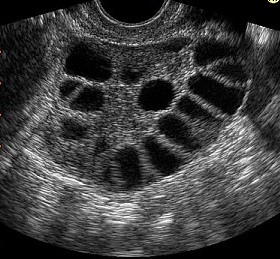
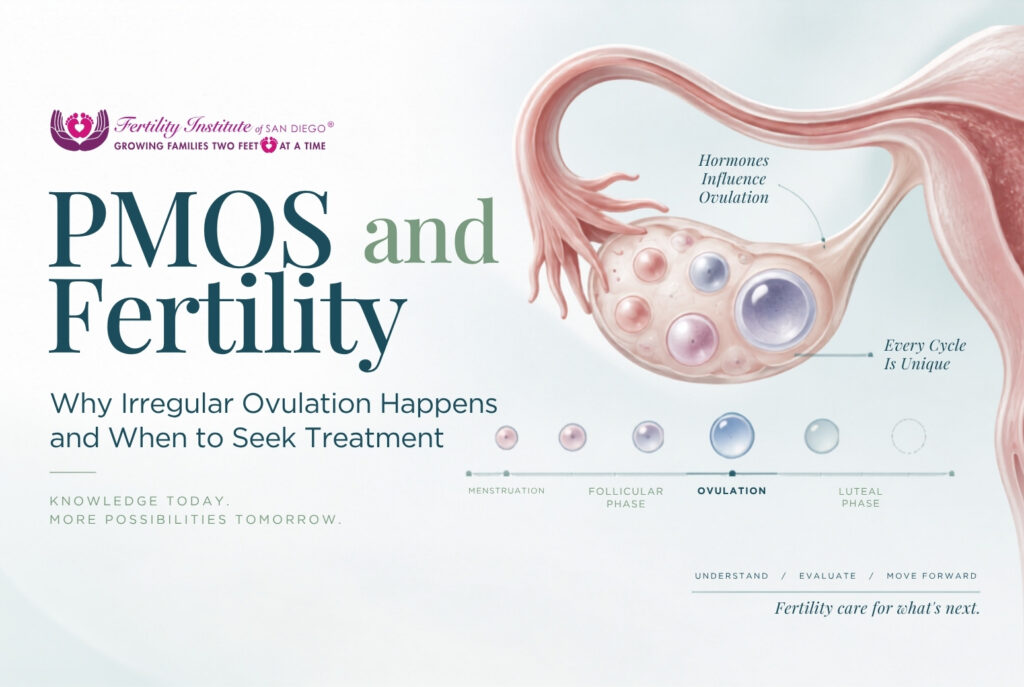
Normally, follicles develop within the ovaries and one becomes dominant before releasing an egg. With PMOS, hormonal signaling can disrupt this follicular maturation process. Follicles may begin developing without consistently reaching the point at which ovulation occurs.
The result can be delayed ovulation, unpredictable ovulation or anovulation, meaning no egg is released during that cycle.
How PMOS Can Affect Fertility
PMOS → Hormonal and Metabolic Signaling Changes → Disrupted Follicle Development → Inconsistent or Absent Ovulation → Irregular Menstrual Cycles → Difficulty Predicting the Fertile Window → Potential Difficulty Conceiving
PMOS can create a more complex path to pregnancy, but many patients can still ovulate and conceive, naturally or with treatment.
Does PMOS Cause Irregular Ovulation?
It frequently can.
Some patients with PMOS ovulate occasionally, others ovulate fairly regularly, and some experience prolonged periods without ovulation. This heterogeneity is one reason PMOS and fertility should be evaluated individually.
Irregular menstrual cycles are often an important clue because menstruation and ovulation are closely connected.
If ovulation occurs on day 14 one month, day 30 another month and does not occur during another cycle, predicting the fertile window becomes extraordinarily difficult. Even when spontaneous conception is biologically possible, intercourse may not coincide with ovulation.
PMOS may therefore affect fertility through both reduced ovulatory frequency and reduced predictability.
Can You Ovulate and Get Pregnant With PMOS?
Yes.
A PMOS diagnosis does not mean that your ovaries cannot release eggs or that pregnancy is impossible. Many patients continue to ovulate spontaneously, although the timing may be inconsistent.
Pregnancy may occur naturally when ovulation is occurring and there are no additional fertility factors.
This is an important distinction because fertility treatment for PMOS is not automatically IVF.
Treatment should instead address the specific reproductive bottleneck identified during evaluation.
How Do I Know Whether I Am Ovulating With PMOS?
Tracking ovulation at home can provide useful information, but PMOS sometimes makes conventional methods more difficult to interpret.
Patients may monitor:
- menstrual cycle patterns
- cervical mucus changes
- basal body temperature
- ovulation predictor kits
- fertility tracking applications
However, irregular hormonal patterns can make calendar-based predictions unreliable, and some patients may find urinary ovulation tests confusing.
A fertility evaluation can provide more objective information through ultrasound, hormonal testing and appropriately timed laboratory studies.
Irregular periods do not necessarily mean zero ovulation.
PMOS can cause:
Regular Ovulation | Delayed Ovulation | Infrequent Ovulation | Anovulation
The question is not simply whether you have periods. The more clinically useful question is whether and how consistently you are releasing an egg.
Should I Wait 12 Months Before Seeing a Fertility Specialist?
Not necessarily.
General infertility guidance often refers to seeking evaluation after 12 months of trying to conceive for patients under 35, or after six months for patients 35 and older.
But known or suspected ovulatory dysfunction changes that conversation.
If your periods are very irregular, months apart or absent, waiting for an arbitrary milestone may provide little benefit. An earlier consultation can determine whether ovulation is occurring and identify other factors that could influence conception.
Consider speaking with a fertility specialist sooner if you have:
- markedly irregular or absent periods
- known PMOS or previous PCOS diagnosis
- difficulty identifying ovulation
- prolonged cycles
- a history of infertility
- concerns about ovarian reserve
- additional reproductive or partner fertility factors
Age also matters. Fertility evaluation should always consider the broader reproductive timeline rather than PMOS in isolation.
What Fertility Tests Are Recommended for PMOS?
Evaluation should look beyond a single hormone result.
Depending on your history, fertility testing for women with PMOS may include assessment of menstrual and ovulatory patterns, reproductive hormones, ultrasound evaluation, ovarian reserve testing such as AMH, and metabolic factors when clinically appropriate.
Partner semen analysis and evaluation of the reproductive tract may also be considered.
This comprehensive approach matters because PMOS may be present alongside another fertility issue.
“One of the most important parts of fertility care is avoiding assumptions. Having PMOS does not mean that every fertility challenge is caused by PMOS. We evaluate the complete reproductive picture before recommending treatment.”
Dr. Minoos Hosseinzadeh, Founder and Medical Director, Fertility Institute of San Diego
Fertility Treatment for PMOS
Treatment generally progresses according to the patient’s individual findings rather than automatically escalating to IVF.
Lifestyle and Metabolic Considerations
When clinically appropriate, nutrition, physical activity, sleep and management of metabolic health may form part of treatment. These recommendations should be individualized rather than assuming every patient with PMOS needs weight loss.
Ovulation Monitoring and Timed Intercourse
Patients who ovulate but have unpredictable cycles may benefit from monitored cycles to identify follicular development and better timed intercourse.
Ovulation Induction
For patients experiencing anovulatory infertility, medications can stimulate ovulation. Letrozole for ovulation induction in PMOS is an important treatment option and is recommended as first-line pharmacological ovulation induction for anovulatory infertility when no other infertility factors are present.
IUI for PMOS
Intrauterine insemination may be considered when clinically indicated, including circumstances involving additional fertility factors. IUI places prepared sperm directly into the uterus around ovulation.
IVF for PMOS
IVF may become appropriate when less invasive approaches have not succeeded or when other fertility findings make IVF a more effective strategy.
With IVF for PMOS, ovarian stimulation, egg retrieval, fertilization and embryo development can be carefully managed within an individualized protocol.
A Personalized PMOS Fertility Treatment Path
- Metabolic and Lifestyle Considerations (When Appropriate) — Nutrition, physical activity, sleep and metabolic health may support hormonal balance and ovarian function.
- Ovulation Monitoring — Ultrasound and hormone testing help track follicle development and identify your fertile window.
- Ovulation Induction — Medications such as letrozole can help stimulate ovulation for patients with anovulatory or irregular cycles.
- Timed Intercourse — With a more predictable ovulation window, intercourse can be timed to increase the chance of conception.
- IUI (Intrauterine Insemination) — When indicated, IUI places prepared sperm directly into the uterus around the time of ovulation.
- IVF (In Vitro Fertilization) — IVF may be recommended when other approaches have not been successful or when additional fertility factors are present.
Every fertility journey is unique. A personalized approach helps identify the most appropriate treatment path for you.
Personalized PMOS Fertility Treatment in San Diego
At the Fertility Institute of San Diego, patients receive individualized fertility care under the direction of Dr. Minoos Hosseinzadeh, a double board-certified reproductive endocrinologist and OB/GYN.
Rather than treating PMOS according to a standardized algorithm alone, the treatment plan can incorporate age, ovulation, ovarian reserve, hormonal findings, reproductive history, partner factors and personal family-building goals.
For someone who has spent months trying to interpret unpredictable cycles, simply understanding what the ovaries are doing can be an important first step.
Frequently Asked Questions About PMOS and Fertility
Does PMOS mean I am not ovulating?
No. Some patients with PMOS ovulate regularly, others inconsistently, and some experience anovulation.
Can I get pregnant naturally with PMOS?
Yes. Spontaneous pregnancy is possible, particularly when ovulation is occurring and there are no other significant fertility factors.
Why does PMOS cause irregular periods?
PMOS can alter the hormonal signaling involved in follicular development and ovulation. When ovulation is delayed or absent, menstrual cycles can become irregular.
When should I see a fertility specialist for PMOS?
Consider earlier evaluation if your periods are markedly irregular or absent, you cannot identify ovulation, or you have additional fertility concerns. You may not need to continue trying for 12 months before asking for help.
Is IVF always necessary for PMOS infertility?
No. Depending on the cause of infertility, treatment may begin with ovulation monitoring, ovulation induction, timed intercourse or IUI. IVF is considered when clinically appropriate.
Understanding Your Ovulation Can Be the First Step Forward
Irregular periods can make conception feel unpredictable, but PMOS does not determine your reproductive future.
The objective is to identify whether ovulation is occurring, evaluate the complete fertility picture and select treatment proportional to what is actually preventing pregnancy.
If you’re ready to start your fertility journey, please book a complimentary virtual consultation with Dr. Hosseinzadeh to discuss fertility options or any other reproductive healthcare questions.